


 Português
 Español


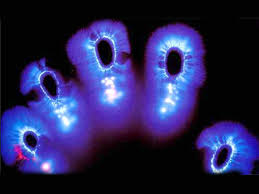
The effects of Pranic Healing are evident, often immediate, to those who experience it. Pranic therapists around the world have helped thousands of people find a state of greater balance and health. Pranic Healing is being adopted by Hospitals(learn more) and Universities(learn more) in several countries, and is being accepted by the scientific community as an efficient and beneficial therapy, as studies with Bioelectrography show.
Monica Abad (Senior Instructor) and Ana Paula da Silva (see) have done a study that was presented at the last congress in the Philippines that sheds a lot of light on this subject. To understand a little better, let’s talk to Monica, who will explain to us a little about the vast world of research she has carried out;
What is Bioelectrography? Bioelectrography results from the capture of gases, vapors, and other body fluids emanating from the pores of the skin. It takes an image of the finger on the plate (?) It is also called Kirlian photography, or aura photography.
GP: What does the device look like and how exactly does it work? How was your experience working with him?
Monica Abad:
The inventor of Kirlian photography was Father Landell(Landell de Moura,) in 1904.
SEE Scientific Method (see list of criteria)
- Verifiability principle: According to the verifiability criterion, a theory is said to be scientific only when the content of a hypothesis can be, at least in principle, verified by experiment. According to this criterion, the verification of the content of a hypothesis or theory consists in demarcating the truth value of that theory;
- principle of falsifiability: is the process of confronting a theory with observational data in an attempt to prove its falsity.
- Criticism of Induction: Popper warns “the 3765 white swan, for example, does not prove that all swans are white, but the first black swan proves that not all swans are white” POPPER, Karl, Open Society – Open Universe, Lisbon, Publicações D. Quixote, 1991
- DeductionThe method used (hypothetical-deductive – conjecture and refutation) can be divided into three fundamental points:
1. Formulation of the hypothesis (a conjecture), which arises by creative reasoning or abduction rather than induction.
2. Deduction of predictive consequences – after the hypotheses are formulated, the consequences of the hypotheses are deduced; and finally experimentation – the hypothesis is tested, and the results of the experiment can confirm or refute it. If the consequences answer positively, the theory is provisionally accepted (only because it could not be refuted – this is what Popper calls falsifiability), if they answer negatively, the theory is rejected. When the theory stands up to the evidence and has not been supplanted by others it is said to be corroborated. It replaces the verifiability criterion with that of falsifiability.
SEE Positivism is a philosophical current that emerged in the 19th century in France by August Comte and John Stuart Mill that holds that scientific knowledge is the only form of true knowledge. The positivist method is based on the observation of phenomena. It limits human experience to the sensible, observable world.
I am
i am that i am
im not the body
i am not the mind]
i am not the thoughts
i am that i am


Fique por dentro!
Proximos Cursos:
No Events
Clique Aqui e Veja nossa Agenda Completa!